
Universe Dawn
- Role
- Lead Engineer, Mobile & Platform (contract), Team Parallax
- Period
- Sep 2022 to Present
Universe Dawn is a sci-fi strategy MMO with a React desktop client, an Expo app for iOS, Android and mobile web, and Node.js microservices. I'm the main engineer, working directly with the founder, and I own the client apps and the API platform.
Game areas brought to desktop parity on mobile
Merged output with the agent platform
Mobile config check, down from 9 s
Screens
Platform and architecture
Next.js to TanStack Start
After login the game runs as a client-side app, so a client router with typed loaders fits it better than a server-first framework. Auth moved into route loaders with signed session cookies. Config loads at runtime, so one image deploys to every environment.
ts-rest contracts at the gateway
The generated API clients kept drifting from the gateway, and every change meant regenerating them. Contracts replaced them, with typed request and response schemas and authorization per route.
One shared-state package
Queries, mutations, WebSocket subscriptions, sessions and the persisted cache live in one package used by desktop and mobile. Each app used to keep its own copy, so a fix often landed on one side only. Sharing that logic made the mobile overhaul possible.
Expo and EAS in CI
I migrated the React Native app to Expo and kept it current through SDK 57 and 58. Each MR gets a preview build with QR codes. Releases ship as OTA updates unless the native fingerprint changed. The app also runs as an installable PWA.
Faster start
Mobile config revalidation went from a 764 KB download, 7 to 9 s on staging, to a 4-byte hash check at about 0.7 s. On desktop, sidebar navigation became instant through viewport preloading and caching tuned to the data the WebSocket already keeps fresh.
Product decisions
Mobile overhaul
93 MRs merged through one integration branch. Fights, fleets, shipyard, chat, quests, the academy and premium reached desktop parity, with the screens redesigned for touch.
Navigation
Five popup menus on one flat stack became a bottom tab bar with a stack per tab. Back no longer jumps across sections, the tab bar shows where you are, and every URL kept working, so deep links didn't break.
Tactical scan radar
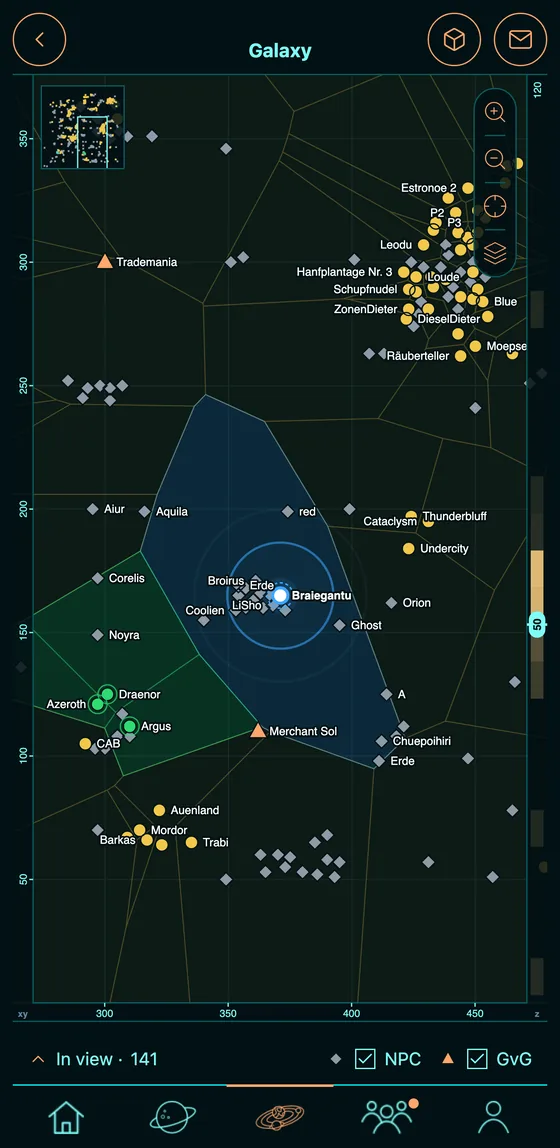
Contacts sit on a square radar inside an x/y/z coordinate frame, with pinch to zoom and a tap that opens a spot card with "Fly here". Before this, players read coordinates off a table.
Push opt-in
The app asks after onboarding or the first fleet send instead of at launch. "Not now" brings the prompt back after 3 days, at most 3 times, and players choose categories. The backend sends through Expo Push in 7 languages and disables dead devices based on push receipts.
Chat moderation
Reporting, blocking and a moderator queue meet Apple guideline 1.2 on user-generated content. Only senders and moderators can delete messages.
Analytics plan
PostHog events match on mobile and desktop through one shared event core, so the clients can't drift. The plan covers the core funnels and consent for session replay.
AI-agent delivery platform
Agents that ship safely
I built and run the platform that lets coding agents ship in a large TypeScript monorepo. It has agent rules, seeded review scenarios with a CI check that gameplay service changes include one, isolated dev stacks, a shared build queue and EAS preview builds for each MR.
Autonomous workers
A Discord Codex worker and a PostHog error intake publish fixes through the same review as every other change.
10x merged output
October 2026 against my February to September monthly average, with screenshot or recording evidence on every MR.